
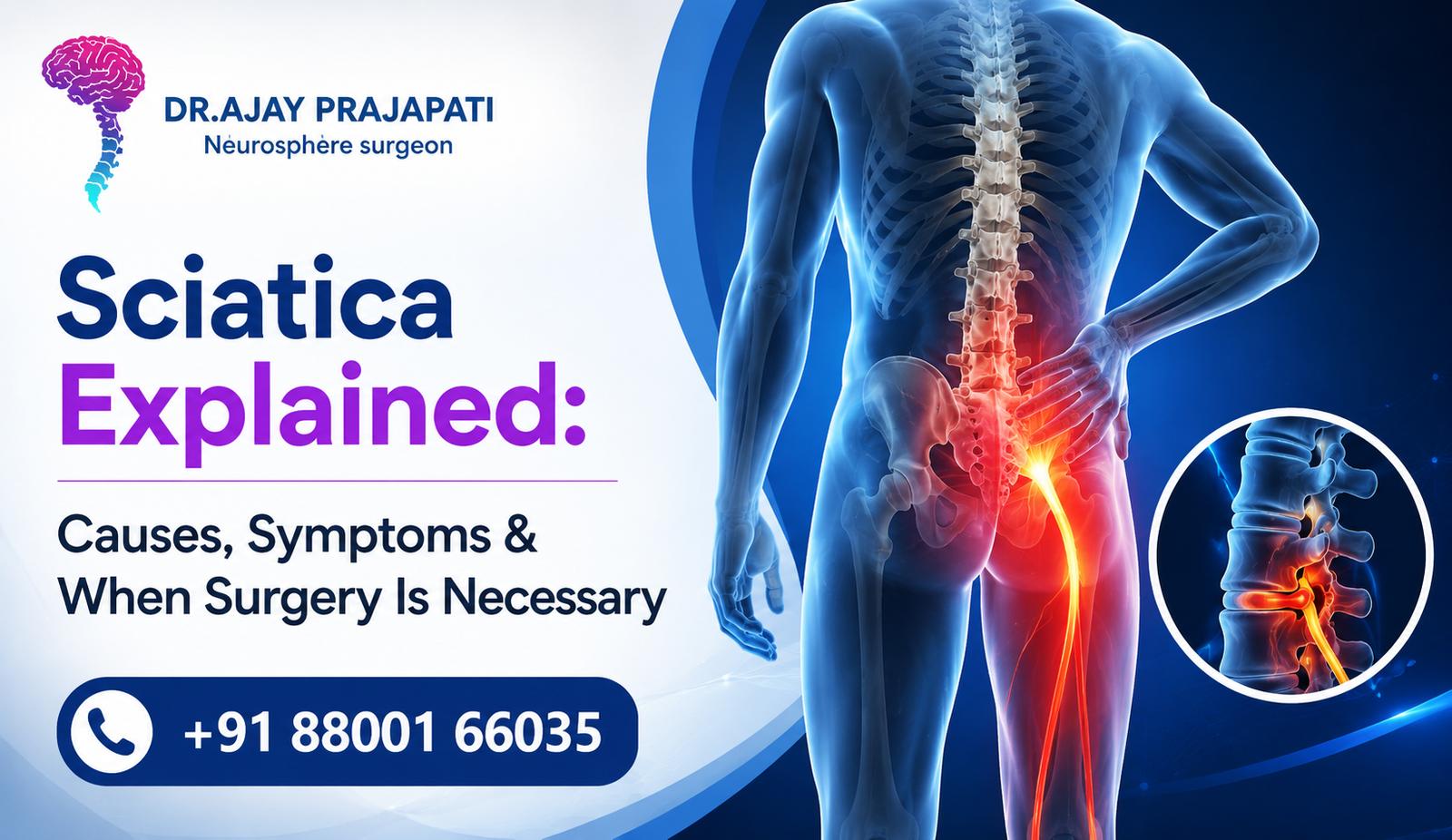
Sciatica Explained: Causes, Symptoms & When Surgery Is Necessary | Dr Ajay Prajapati
Introduction
Back pain is frustrating. But when that pain shoots down your leg like an electric current — making it hard to walk, sit, or even sleep — it could be sciatica. Millions of people in India experience sciatica every year, yet many of them wait too long before seeking the right care.
If you or someone you love is looking for the best sciatica treatment in Noida, this guide will help you understand exactly what sciatica is, what causes it, how it is treated, and — most importantly — when surgery is actually the right choice.
What Is Sciatica?
Sciatica is not a disease in itself. It is a symptom — a sign that your sciatic nerve is being compressed or irritated somewhere along its path.
The sciatic nerve is the longest and widest nerve in the human body. It starts in your lower back, runs through your hips and buttocks, and travels all the way down each leg to your feet. When anything presses on this nerve — a slipped disc, a bone spur, or a narrowed spinal canal — it triggers pain, numbness, or tingling along that entire pathway.
Common sciatica symptoms include:
- Sharp, shooting pain from the lower back down one leg
- Burning or tingling sensation in the leg or foot
- Numbness or weakness in the affected leg
- Pain that worsens when sitting, sneezing, or coughing
- Difficulty standing up or walking for long periods
Most people experience sciatica on one side of the body. In rare cases, both sides can be affected.
What Causes Sciatica?
Understanding the root cause is the first step toward the right sciatica treatment. The most common causes include:
1. Herniated or Slipped Disc This is the most frequent cause of sciatica. When the soft inner material of a spinal disc pushes out through its outer layer, it can press directly on the sciatic nerve.
2. Lumbar Spinal Stenosis This is a narrowing of the spinal canal in the lower back, which puts pressure on the nerves passing through it. It is especially common in people above 50 years of age.
3. Piriformis Syndrome The piriformis muscle, located deep in the buttock, can sometimes tighten or spasm and irritate the sciatic nerve beneath it.
4. Spondylolisthesis When one vertebra slips forward over another, it can compress the sciatic nerve root and trigger sciatica symptoms.
5. Spinal Tumours or Infections Though rare, abnormal growths or infections near the spine can also press on the sciatic nerve.
Can Sciatica Be Treated Without Surgery?
Yes — and in most cases, it should be tried first.
For the majority of sciatica patients, conservative (non-surgical) sciatica treatment works very well. About 80–90% of people recover without needing an operation. Here is what non-surgical treatment looks like:
- Rest and activity modification — Avoid movements that make the pain worse, but do not stay completely inactive.
- Physiotherapy and sciatica exercises — Stretching and strengthening the muscles around the spine can relieve pressure on the sciatic nerve. Simple sciatica exercises without surgery, done consistently, can bring significant relief.
- Pain medications — Anti-inflammatory drugs like ibuprofen or prescribed medications can reduce pain and swelling.
- Epidural steroid injections — Injections delivered near the affected nerve can provide significant short-term relief.
- Hot and cold therapy — Applying ice packs or heat pads can ease muscle spasms and inflammation.
Most patients see improvement within 4 to 6 weeks of consistent conservative treatment. Patience and guidance from the right spine specialist make a big difference.
Best Sciatica Exercises to Try at Home
Sciatica exercises are one of the most effective ways to manage pain without surgery. Here are a few safe options:
- Knee-to-chest stretch — Lie on your back, pull one knee gently to your chest, and hold for 20–30 seconds. This releases tension in the lower back.
- Piriformis stretch — Cross one ankle over the opposite knee and gently pull toward your chest. This targets the muscle that often irritates the sciatic nerve.
- Cat-cow stretch — On all fours, alternate between arching and rounding your back slowly. This improves spinal flexibility and reduces nerve pressure.
- Seated hamstring stretch — Sit on the edge of a chair and extend one leg straight. Lean forward slightly until you feel a gentle pull at the back of the thigh.
Always perform sciatica exercises under the guidance of a physiotherapist, especially if your pain is severe.
When Is Surgery Necessary for Sciatica?
This is the most important question — and it deserves a clear, honest answer.
Surgery for sciatica is not the first option. However, there are specific situations where surgery becomes necessary and, in fact, urgent. Consulting the best spine surgeon in Noida early ensures you do not miss the right treatment window.
You may need sciatica surgery if:
- Conservative treatment has failed — If you have tried physiotherapy, medications, and injections for 6 to 12 weeks without meaningful relief, surgery may be the next step.
- Pain is severe and disabling — When sciatica pain is so intense that you cannot perform basic daily activities, surgery can offer faster and more lasting relief.
- You experience weakness in the leg — Progressive muscle weakness in the leg or foot is a warning sign that nerve damage may be worsening. Delaying surgery in this case can lead to permanent weakness.
- Bladder or bowel problems develop — Loss of control over bladder or bowel function is a medical emergency called Cauda Equina Syndrome. This requires immediate surgery — do not wait.
- Symptoms keep returning — Recurring episodes of severe sciatica that do not respond to treatment are another reason to consider a surgical solution.
What Types of Surgery Are Used for Sciatica?
Modern spine surgery has come a long way. Patients now have access to minimally invasive options that mean smaller cuts, less blood loss, and faster recovery.
Common surgical procedures for sciatica include:
- Microdiscectomy — The most common surgery for sciatica caused by a herniated disc. A small portion of the disc pressing on the nerve is removed through a tiny incision.
- Endoscopic Spine Surgery — An even less invasive approach using a thin tube and camera to decompress the sciatic nerve.
- Laminectomy — Removal of a small section of bone (the lamina) to create more space for the nerve, commonly done for spinal stenosis.
- Spinal Fusion — Used when vertebral instability is contributing to nerve compression.
Recovery from minimally invasive sciatica surgery is typically much faster than traditional open surgery. Most patients are back to light activities within 2 to 4 weeks.
Do Not Ignore These Red Flag Symptoms
Seek immediate medical attention if you experience any of the following:
- Sudden loss of bladder or bowel control
- Severe numbness in the inner thigh or groin area
- Rapidly worsening leg weakness
- Sciatica following a serious accident or fall
These signs could indicate Cauda Equina Syndrome — a rare but serious condition that requires emergency surgery within hours. A qualified back pain specialist in Noida can quickly assess these symptoms and guide you to the right care.
Conclusion
Sciatica can range from mildly annoying to completely life-disrupting. The good news is that most people recover well without surgery — especially with the right sciatica exercises, medications, and early treatment. But when conservative sciatica treatment is not working, or when serious symptoms appear, surgical intervention can be life-changing.
If you are struggling with persistent sciatica pain, do not wait until things get worse. Consulting the best spine surgeon in Noida at the right time can save you months of unnecessary suffering and help you get back to the life you deserve.
FAQs About Sciatica
Q1. How long does sciatica usually last?
Most cases improve within 4 to 6 weeks with rest and physiotherapy.
Q2. Can sciatica go away on its own without surgery?
Yes, mild sciatica often resolves with rest and sciatica exercises. See a specialist if pain is severe or recurring.
Q3. Who should I consult for sciatica treatment?
Consult an experienced neurospine surgeon to identify the root cause and get the right treatment plan.
Q4. What sciatica exercises help relieve pain at home?
Knee-to-chest pulls, piriformis stretches, and cat-cow movements are effective. Always do them under a physiotherapist's guidance.
Q5. Can sciatica come back after surgery?
Surgery usually provides lasting relief. Maintaining good posture, a healthy weight, and core strength can reduce the risk of recurrence.