
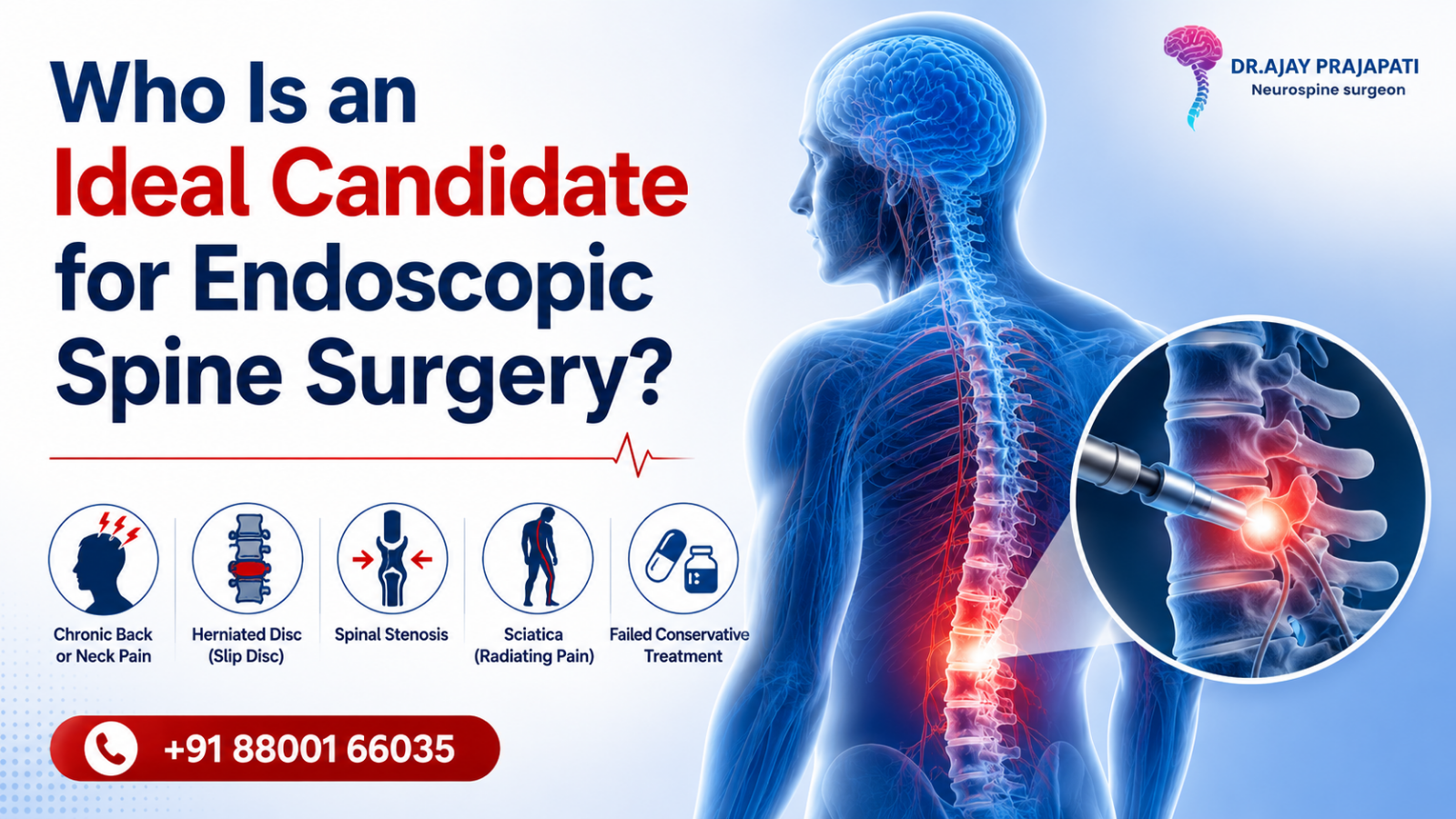
Who Is an Ideal Candidate for Endoscopic Spine Surgery?
Back pain has become one of the most common health complaints in the world. Millions of people live with chronic spinal conditions that limit their movement, disrupt sleep, and gradually erode their quality of life. For many of them, conservative treatments — physiotherapy, medications, and injections — simply stop working over time.
Endoscopic spine surgery has emerged as a powerful, minimally invasive alternative to traditional open spine surgery. But it is not for everyone. Knowing whether you are an ideal candidate is the critical first step before considering this procedure.
What Is Endoscopic Spine Surgery?
Endoscopic spine surgery is a minimally invasive surgical technique that uses a small camera (endoscope) and specialised instruments inserted through a tiny incision — often less than a centimetre — to treat spinal problems. The surgeon views the operative field on a monitor in real time and works with precision without cutting through large amounts of muscle or tissue.
Compared to traditional open spine surgery, endoscopic procedures offer significantly less blood loss, shorter hospital stays, faster recovery, and reduced risk of infection. Most patients return home the same day or within 24 hours.
Conditions That Make You a Potential Candidate
Not every spinal condition qualifies for endoscopic treatment. The following are the most common diagnoses where endoscopic spine surgery delivers strong outcomes:
Herniated Disc (Slipped Disc) This is the most frequent indication. When the soft inner core of a spinal disc pushes through its outer casing and presses on a nerve, it causes radiating pain, numbness, and weakness in the arms or legs. Endoscopic discectomy can remove the offending disc fragment with remarkable precision.
Spinal Stenosis Narrowing of the spinal canal compresses nerves and causes pain, cramping, and heaviness in the legs — especially while walking. Endoscopic decompression effectively widens the canal without destabilising the spine.
Foraminal Stenosis When the bony openings through which spinal nerves exit the spine become narrowed, it causes persistent nerve pain down the arm or leg. Endoscopic foraminoplasty can enlarge these openings and relieve pressure.
Degenerative Disc Disease: Wear and tear of spinal discs over time can cause chronic pain and instability. In select patients, endoscopic techniques can address the damaged disc tissue causing symptoms.
Facet Joint Cysts: Fluid-filled cysts that develop around the facet joints of the spine can compress nerves. These can often be removed endoscopically with minimal disruption to surrounding structures.
Patients from sectors across Noida — including Sector 18, Sector 62, and Sector 137 — who have been living with any of these conditions and haven't found relief through non-surgical care should consider speaking with the best brain and spine specialist in Noida to explore whether endoscopic surgery is appropriate.
Who Is the Ideal Candidate?
The ideal candidate for endoscopic spine surgery typically meets several specific criteria:
1. Failed Conservative Treatment:t The most important criterion. Ideal candidates have already tried and not responded adequately to at least 6–12 weeks of structured conservative treatment — including physiotherapy, anti-inflammatory medications, nerve blocks, or epidural steroid injections. Surgery is not the first recommendation; it is considered when non-surgical options are exhausted.
2. Clearly Identified Source of Pain Endoscopic surgery works best when the cause of pain is precisely pinpointed on imaging — MRI or CT scan. Vague, diffuse pain without a clear structural cause on imaging is not a suitable indication for this procedure.
3. Nerve Compression Confirmed on MRI Patients with documented nerve compression or disc herniation confirmed through imaging — with symptoms that match the location of compression — are the strongest candidates.
4. No Severe Spinal Instability Endoscopic spine surgery is ideal for decompression procedures, es but is generally not suitable for patients who need spinal fusion to stabilise the vertebrae. Conditions like severe spondylolisthesis with instability typically require open fusion surgery.
5. Absence of Severe Bone Deformity Significant spinal deformity — such as advanced scoliosis — may limit the surgical approach and require open techniques instead.
6. Overall Medical Fitness While endoscopic surgery is less invasive, patients must still be medically fit for anaesthesia and the procedure itself. Uncontrolled diabetes, bleeding disorders, or active infections may need to be addressed first.
7. Realistic Expectations The ideal candidate understands that surgery addresses structural causes of pain — it does not eliminate all discomfort overnight. Post-operative physiotherapy and lifestyle changes remain essential parts of recovery.
Who Is Not an Ideal Candidate?
It is equally important to understand who should not undergo endoscopic spine surgery:
Patients whose pain is primarily caused by psychological or functional factors rather than structural spinal pathology
Those with severe multi-level spinal instability requiring fusion at multiple levels
Individuals with active spinal infection or tumour involving complex reconstruction
Patients who have not yet completed a proper course of conservative treatment
If you experience chronic headaches alongside spine-related symptoms, it is worth noting that the best neuro doctor for headache in Noida can help differentiate between cervicogenic headaches — those originating from neck and spine issues — and primary headache disorders, ensuring you receive the right treatment pathway.
Benefits of Endoscopic Spine Surgery for Ideal Candidates
When the right patient undergoes endoscopic spine surgery, the outcomes are impressive:
Tiny incision — typically under 1 cm, leaving minimal scarring
Preservation of muscle — no large muscle cuts, meaning faster functional recovery
Day-care procedure — most patients go home the same day
Faster return to work — many patients resume desk jobs within 1–2 weeks
Lower infection risk — a smaller wound means significantly reduced infection rates
Less blood loss — often performed without a single unit of blood transfusion
Local or sedation anaesthesia — possible in select cases, reducing systemic risk
The Consultation Process — What to Expect
Before any surgical decision is made, a comprehensive evaluation is essential. This typically includes a detailed neurological examination, review of MRI and CT imaging, assessment of symptom duration and severity, and a frank discussion about surgical goals and recovery expectations.
Patients across Noida and surrounding areas, including Indirapuram, Vaishali, and Crossings Republik, seeking clarity on persistent back or neck pain should consult the best brain and spine specialist in Noida for an evidence-based assessment that puts their long-term spine health first.
Conclusion: The Right Procedure for the Right Patient
Endoscopic spine surgery is not a universal solution — it is a precision tool for the right diagnosis in the right patient. When carefully selected candidates undergo this procedure, the results can be genuinely life-changing: relief from chronic pain, restored mobility, and a return to the activities that matter most.
If conservative treatment has let you down and your MRI shows a clear structural cause for your symptoms, endoscopic spine surgery may be exactly what you need. But the journey begins with an expert opinion.
Residents of Noida looking for trusted neurological and spine care can book a consultation with the best neuro doctor for headache in Noida and spine specialist to receive a complete evaluation and a clear, honest answer on whether endoscopic surgery is the right path forward for you.
Your spine supports everything you do — make sure it gets the expert attention it deserves.
FAQs
Q1. How long does endoscopic spine surgery take?
Most procedures are completed within 1–2 hours,s depending on the complexity of the condition being treated.
Q2. Is endoscopic spine surgery painful?
Discomfort is minimal compared to open surgery. Most patients manage post-operative pain with mild oral medications.
Q3. How soon can I walk after endoscopic spine surgery?
Most patients are encouraged to walk within a few hours of the procedure on the same day.
Q4. Are the results permanent?
Results are long-lasting in most cases, though lifestyle habits and physiotherapy play a key role in maintaining outcomes.
Q5. Is endoscopic spine surgery safe for elderly patients?
Yes, in many cases. Its minimally invasive nature actually makes it a safer option for older patients compared to traditional open surgery.