
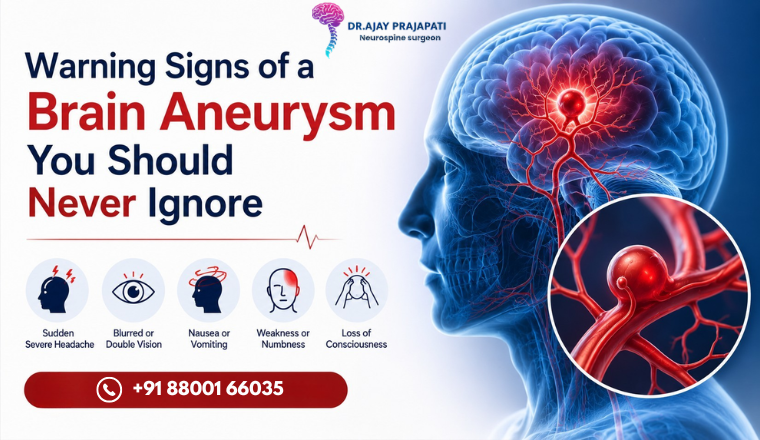
Warning Signs of a Brain Aneurysm You Should Never Ignore
There are medical emergencies that announce themselves loudly — and then there is a brain aneurysm, which can lurk silently for years before delivering a catastrophic, life-threatening event with little to no warning. Yet, in many cases, the body does send signals. The tragedy is that most people either don't recognise them or dismiss them as something minor.
A brain aneurysm is a bulge or ballooning in a blood vessel in the brain caused by a weakness in the vessel wall. If it ruptures, blood floods the space around the brain — a condition called subarachnoid haemorrhage — which is fatal in about 40% of cases. Even survivors often face permanent neurological damage.
The difference between life and death, or between full recovery and lasting disability, frequently comes down to one thing: how quickly you act.
What Causes a Brain Aneurysm?
Before diving into warning signs, it helps to understand what puts a person at risk. Aneurysms form when the wall of a blood vessel weakens. Contributing factors include:
High blood pressure — the single biggest risk factor
Smoking, which damages blood vessel walls over time
Family history of aneurysms
Connective tissue disorders like Marfan syndrome
Polycystic kidney disease
Head injury or trauma
Heavy alcohol use
Aneurysms are more common in women and typically appear after age 40, though they can affect anyone at any age, including children.
The "Thunderclap Headache" — The Most Critical Warning Sign
If you remember only one thing from this article, let it be this: a sudden, severe headache that feels like the worst pain of your life is a medical emergency.
Neurologists call it the "thunderclap headache" — it reaches peak intensity within seconds, often described by patients as being "hit over the head with a baseball bat." This type of headache is the hallmark symptom of a ruptured brain aneurysm and must be treated as an emergency until proven otherwise.
Do not take a painkiller and lie down. Do not wait to see if it passes. Call emergency services immediately.
Patients across sectors like Sector 18, Sector 62, and Rajnagar Extension who experience this kind of sudden, explosive headache should seek immediate care and follow up with the best neuro doctor for headache in Noida as soon as they are stabilised.
Warning Signs of an Unruptured Aneurysm
This is where it gets more nuanced. An unruptured aneurysm — one that is growing but hasn't burst — can produce subtle symptoms as it presses on surrounding brain tissue or nerves. These symptoms are often mistaken for migraines, eye strain, or stress.
Watch for:
1. Pain Behind or Above One Eye A growing aneurysm near the base of the brain can press on the oculomotor nerve, causing pain that is localised around one eye. This is not a typical tension headache — it is persistent, localised, and often accompanied by visual changes.
2. A Dilated Pupil One pupil appearing larger than the other, particularly when paired with eye pain or a drooping eyelid, is a significant neurological red flag. This suggests nerve compression from a nearby aneurysm and requires urgent evaluation.
3. Double or Blurred Vision. Pressure from an aneurysm on the optic nerve or surrounding structures can cause sudden visual disturbances. If your vision changes without an obvious cause — and especially if it accompanies a headache — do not ignore it.
4. Drooping Eyelid (Ptosis) A sudden drooping of one eyelid with no prior history of the condition can indicate that an aneurysm is pressing on the nerves that control eyelid movement.
5. Numbness or Weakness on One Side of the Face Facial numbness, tingling, or weakness — particularly when confined to one side — can signal that an aneurysm is exerting pressure on cranial nerves.
6. Difficulty Speaking or Understanding Speech.h Aneurysms in certain areas of the brain can impair language processing. If someone suddenly struggles to form words or understand what is being said, it warrants immediate neurological assessment.
7. Stiff Neck A stiff neck occurring alongside a severe headache and sensitivity to light — without any cold or flu symptoms — is a classic triad that suggests bleeding around the brain and demands emergency care without delay.
Symptoms After Rupture — Recognise the Emergency
When an aneurysm ruptures, the symptoms are dramatic and unmistakable. Suddenly, a severe "thunderclap" headache
Loss of consciousness or fainting
Nausea and vomiting
Extreme sensitivity to light (photophobia)
Seizures
Confusion or sudden change in mental state
Stiff neck
Every minute after a rupture, millions of brain cells die. Time is brain. Anyone displaying these symptoms needs emergency care within the shortest possible window.
Residents of areas like Sector 137, Sector 50, and Atta Market in Noida should be aware that the best brain and spine specialist in Noida can provide both emergency neurological care and planned intervention for diagnosed aneurysms before rupture occurs.
The "Sentinel Headache" — The Warning Shot Most People Miss
In the days or weeks before a full rupture, some patients experience what is called a sentinel headache — a sudden, unusually severe headache that resolves on its own within hours. Many people dismiss it as a bad migraine or stress-related headache and never seek care.
This is one of the most dangerous missed opportunities in neurology. A sentinel headache is the brain's warning shot. Patients who seek evaluation after a sentinel headache and receive timely treatment have dramatically better outcomes than those who wait for rupture.
If you experience a headache that is unusually severe, sudden in onset, and unlike any headache you have had before — even if it goes away — see a neurologist promptly.
How Is a Brain Aneurysm Diagnosed?
If a brain aneurysm is suspected, your doctor will typically recommend:
CT scan — the fastest way to detect bleeding around the brain
CT Angiography (CTA) — images blood vessels in detail
MRI and MR Angiography — excellent for detecting unruptured aneurysms
Lumbar puncture (spinal tap) — checks for blood in cerebrospinal fluid when CT is inconclusive
Cerebral angiography — the gold standard for mapping the size and location of an aneurysm
People across Noida and the surrounding region who have a family history of aneurysms or persistent unexplained headaches should consider a preventive consultation with the best neuro doctor for headache in Noida to rule out vascular abnormalities before they become emergencies.
Treatment Options
Not every aneurysm requires immediate surgery. The approach depends on size, location, and the patient's overall health. Options include:
Surgical clipping — a neurosurgeon places a metal clip at the base of the aneurysm to stop blood flow into it
Endovascular coiling — a minimally invasive procedure where a catheter is guided to the aneurysm and soft coils are placed inside to prevent rupture.
Flow diversion — a newer technique using stent-like devices to redirect blood flow away from the aneurysm
Watchful waiting — small, stable aneurysms in low-risk patients may be monitored with regular imaging
Conclusion: Never Dismiss the Unusual
A brain aneurysm does not always roar. Sometimes it whispers — through a drooping eyelid, a strange headache, a momentary blurring of vision. The problem is that we are trained to explain away subtle symptoms and only respond to the dramatic ones.
Learn the warning signs. Share them with your family. And if something feels neurologically wrong — especially involving a sudden severe headache — trust that instinct and seek care immediately.
For comprehensive neurological evaluation, advanced imaging, and expert management, consulting the best brain and spine specialist in Noida could be the decision that saves your life or the life of someone you love.
When the brain signals danger, listen. It rarely gets a second chance to warn you.
FAQs
Q1. Can a brain aneurysm go away on its own?
No. Aneurysms do not resolve on their own. Small ones may be monitored, but they require specialist oversight.
Q2. Is a brain aneurysm always fatal? Not always.
With prompt treatment, many patients survive and recover, especially when caught before rupture.
Q3. Can stress cause a brain aneurysm to rupture?
Sudden spikes in blood pressure from extreme stress or physical exertion can trigger rupture in a weakened vessel.
Q4. Are brain aneurysms hereditary?
Yes, to a degree. Having a first-degree relative with an aneurysm increases your risk and warrants screening.
Q5. What is the fastest way to detect a brain aneurysm?
A CT scan or CT angiography is the quickest diagnostic tool, especially in emergencies involving a sudden, severe headache.